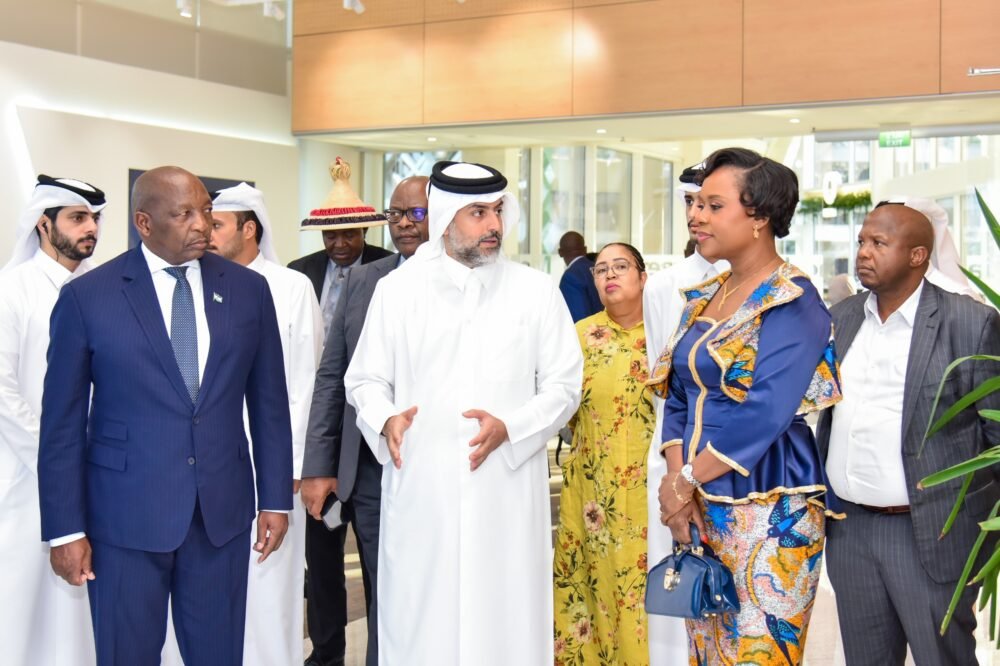
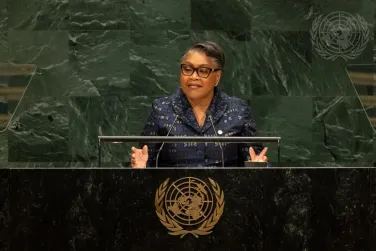
Judith Suminwa Tulukam, Prime Minister of the Democratic Republic of Congo, reminded the Assembly that her country is still confronted with a “war of aggression waged by Rwanda” under the guise of the Alliance Fleuve Congo/March 23 Movement (AFC/M23).
Few situations lay bare the gap between international commitments and lived reality as the conflict in the east of the Democratic Republic of Congo, she said.
Several steps — including a peace agreement signed in Washington, D.C., in June 2025 — have opened up prospects for peace, but for millions of Congolese, peace remains only a promise, she said.
While Security Council resolution 2773 (2025) lays out an unambiguous path forward, “We do not need new texts to replace those which have already been adopted. What we need is their implementation.”
It is paradoxical that the natural resources fueling conflict in Democratic Republic of Congo are also those that a changing global economy depend upon, she continued. “The governance of strategic resources ought to be an issue of peace, development and global security from now on.”
Noting that her country is the world’s leading source of cobalt and a major producer of copper, she declared: “We cannot build a decarbonized economy through bloodstained minerals.” Going forward, Democratic Republic of Congo wants to play a bigger role in the processing of its raw materials, beyond their crude extraction, in ways that will create jobs, she said.
She went to discuss the ways in which Democratic Republic of Congo is strengthening mechanisms to combat child labour, with the goal being “zero children in mines”.
“The real proof of a responsible supply chain is not the electric vehicle sold downstream. It is the child who no longer descends into the mine upstream,” she said.